Inner Light

What Joseph’s Quaker faith asked of him.

To understand Joseph Olejak’s tax refusal, his jail journal, and the way he saw the men inside, it helps to understand the Quaker language beneath it: Inner Light, peace testimony, integrity, and the belief that every person carries “that of God” within them.

That of God

What Quakers mean by the Inner Light.

Many Quakers, also called Friends, speak of "that of God" in every person. The phrase points toward a shared vision of the Divine: look for the sacred worth of a person before accepting the world's smallest description of them.

It's not just sentimental optimism. It is a way of seeing, listening, and engaging the world within and without, especially when fear, anger, shame, or judgment makes that difficult.


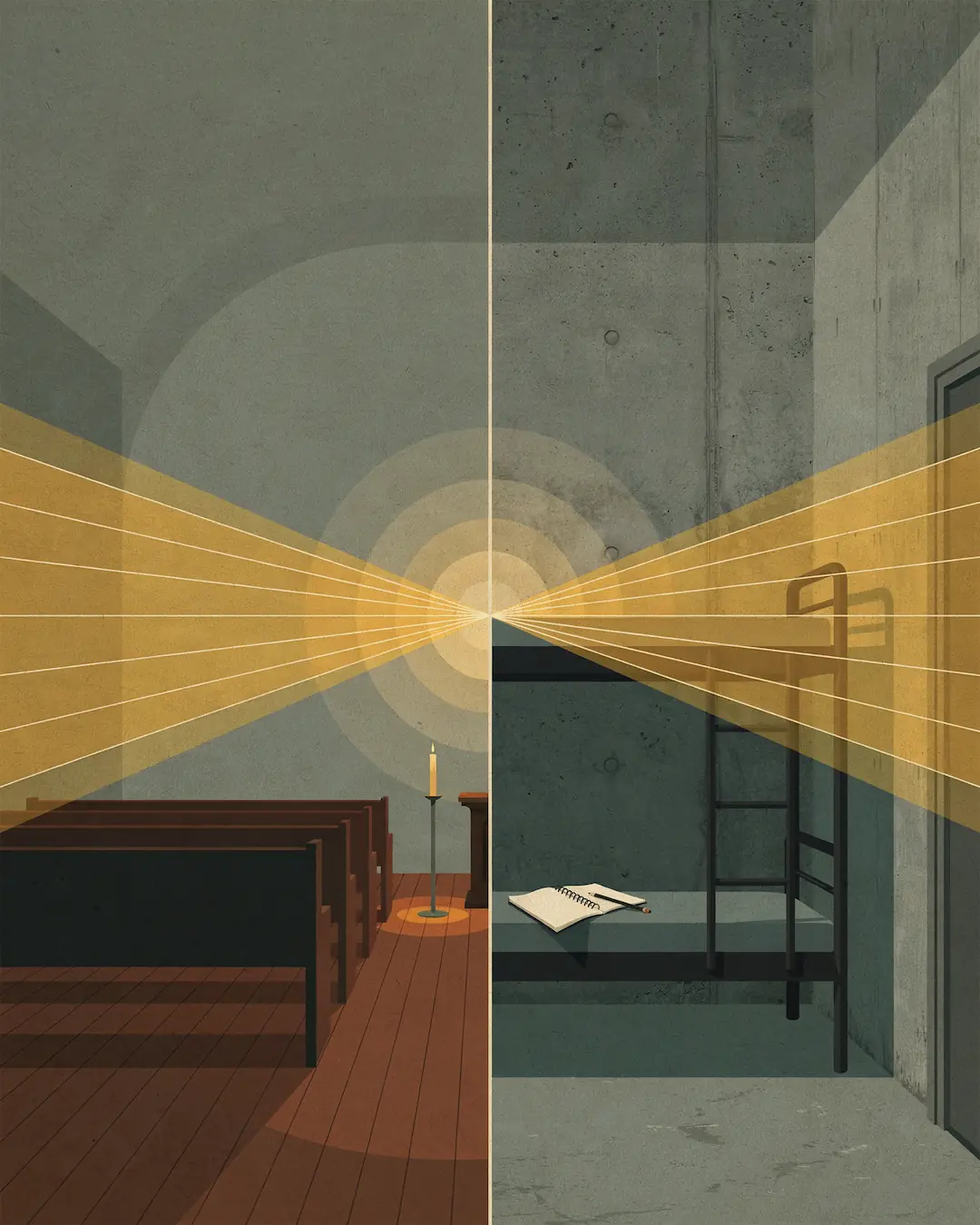
A quiet visual meditation on seeing the sacred worth within another person.
Inner Light asks a person to look again before accepting the smallest story the world has given someone.
A quiet visual meditation on Quaker peace testimony and public responsibility.
For Joseph, peace testimony became a question of what he could fund, what he had to refuse, and how he could remain faithful in public life.

Peace witness

Peace testimony is more than being against war.

Quaker peace testimony has long asked Friends not to separate faith from violence, public life, or state power. It is not simply a private preference for calm. It is a question about what a person can support, fund, excuse, or normalize while still trying to live truthfully.

For Joseph, peace testimony did not mean withdrawal from public responsibility. It raised the harder question of whether public responsibility could be separated from military violence.

His refusal to fund war is one expression of that larger testimony. It belongs to a faith system older than his own case: the demands of conscience, public responsibility, and the pressure of living under systems that ask ordinary people to participate in harm.

Integrity

Integrity means words and actions have to meet.

"Words and actions have to align if there is to be integrity in the world."

Integrity is one of the central Quaker testimonies. In plain language, it means wholeness: refusing to say one thing and live another, refusing the comfort of a double life, and letting truth reach beyond belief into conduct.

Joseph understands integrity as alignment. Conscience isn't satisfied simple because a person feels strongly about something. It becomes complete when it begins to change how a person acts. For Joseph, that alignment eventually carried public consequences. And led him to a deeper understanding of state violence and punishment against those abroad and at home.

The discipline of attention

Listening is one way Friends practice faith.

Quaker worship and discernment are shaped by listening: waiting in silence, attending to conscience, and making room for truth to become clear. Listening is not passivity. It is restraint, humility, and attention to "that of God" in another person.

Inside jail, Joseph's faith and practice moved into a noisy, stressful, punitive environment where those people were pushed toward quick judgment, anger, and self-protection.

"I stop taking myself away and start listening. That's all I have to give. Maybe in this situation that is enough."

Joseph Olejak

SPICE

SPICE gives Joseph a practical language for witness.

"As a Quaker, I do my best to adhere to SPICE: Spirituality. Peace. Integrity. Community and Equality."

Many Friends summarize Quaker testimonies through SPICE. Josephreads his life through them.

A quiet visual meditation on Quaker testimonies becoming practical daily witness.
SPICE gives Joseph a practical language for faith under pressure: spirituality, peace, integrity, community, and equality.

Spirituality

For Joseph, spirituality includes silence, prayer, inward listening, yoga, and attention to the voice of conscience.

Peace

Peace is not only the absence of violence. It is the refusal to dominate, dismiss, or fund harm.

Integrity

Words and actions must align, especially when that alignment becomes inconvenient.

Community

Witness is personal, but it is not solitary. Joseph's Meeting and local friends helped sustain him.

Equality

Refusing to see himself as above the men inside, even when their lives and charges differed from his own.

A quiet visual meditation on Quaker journals, letters, conscience, and public witness.
Joseph’s jail journal stands within a longer Friends tradition of writing from conscience under public pressure.

A longer lineage

Joseph's journal belongs to a longer Quaker lineage.

Long before Joseph wrote from Columbia County Jail, Friends had used journals and letters to test conscience against the demands of the state. Quaker writing often asks practical questions: What does truth require? What does money support? What does peace mean when public life is tied to violence?

John Woolman, an eighteenth-century Friend, is one of the best-known examples. His journal records a struggle with conscience in relation to slavery, war, money, and public responsibility. In 1755, Woolman and other Friends, including Anthony Benezet, objected to taxes used for military purposes, especially military fortifications.

Joseph wasn't reenacting Woolman's experience but his jail journal stands in conversation with a Quaker experience of writing from a place of integrity under public pressure.

The men inside

The men inside made the belief concrete.

Jail tested these principles in ordinary, uncomfortable ways: noise, fear, boredom, anger, discomfort, hierarchy, dirty work, illness, and the presence of people one might judge too quickly.

It did not make everyone equal in a simple way. Joseph shared space with men whose lives had been shaped by different vulnerabilities: race, poverty, addiction, military trauma, debt, family separation, and legal precarity.

Continue the witness

Read the story, or bring Joseph into conversation.

Joseph’s story is one of faith that moves from belief into action, consequence, and encounter: into court, into jail, into family and professional cost, and into the lives of men he came to know inside. Read the book, or invite Joseph into conversation with your meeting, classroom, congregation, book club, or justice-focused community.