Why I Stopped Paying Taxes QuakerSpeak
Joseph explains the act of conscience that led to his weekends in county jail.
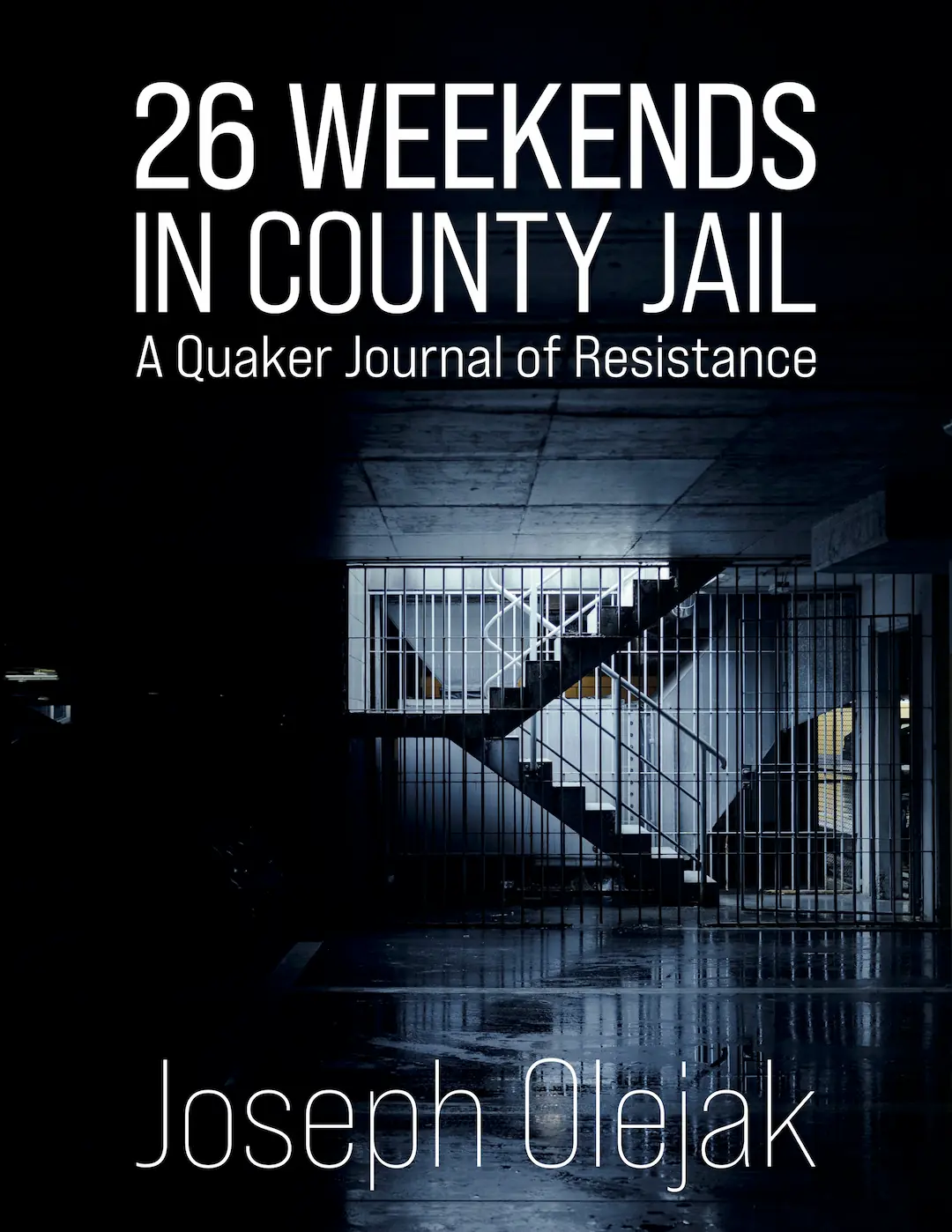
A memoir about conscience and consequences
What he saw became a journal of confinement and witness: inhumane conditions, the lives of the men inside, a system that kept pulling them back, and the Inner Light that called Joseph to bear witness and encourage others.
An act of conscience
Joseph’s refusal began as a matter of conscience: he would not willingly fund war. The sentence that followed did not end that witness. It widened it, bringing him face to face with the routines of jail, the people held there, and the systems of punishment and abandonment his journal would later name.
Why I Stopped Paying Taxes QuakerSpeak
Joseph explains the act of conscience that led to his weekends in county jail.
Early readers
Early readers reflect on 26 Weekends in Country Jail noting the book’s willingness to face what the justice system often conceals: addiction, punishment, poverty, and a bureaucracy that preys on vulnerable communities.
“Joseph Olejak’s book, 26 Weekends in County Jail, struck a deep chord in me. The words in this book aren’t just a glimpse into a broken system; they are a deep reflection of his heart and his goal of making a difference in this world. This isn’t just a well-written, thoughtful story; it is a reflection of what is possible if we step up and not just talk about what is right, but do something about it.”
“A wonderful, important work. I learned a great deal about our penitentiaries and heroin addiction. [The author's ability to] connect with fellow inmates is laudable. Olejak turned what could have been a totally horrific 26 weekends into a rich, deep learning experience and a lesson on how to connect with people different from ourselves. BRAVO!”
“Joseph Olejak’s book, 26 Weekends in County Jail, is an excellent read. The story of his time spent in jail is a self-aware tale that asks the reader to lean in and look more deeply within themselves. The systems of our society are laid bare in their insufficiencies. The book brings readers to ask questions of themselves regarding their own involvement with society.”
“Through a unique lens, Olejak shares his experience of 26 weekends in various blocks of a county jail with honesty, insightful inquiry, willingness to face his own stereotypes, and compassion. Sharing his knowledge of chiropractic care, natural medicine, and personal development with fellow inmates as well as readers, he weaves a compelling story of making a difference by serving others rather than solely serving time.”
“Whether you fully agree with the author’s conclusions about how to fix war taxes, the American prison system, and Big Pharma, he raises critical questions based on his incarceration experience.”
“Through the stories of the men Olejak meets, we come to understand that, far from rehabilitation, the penitentiary system in the United States functions as a for-profit warehouse. It uses bureaucracy, emotional and physical violence, and a cruel, mostly disinterested sadism to process human lives for profit. Then it ensures they’ll be back again and again through textbook bureaucratic chicanery.”
The book
In 1995, after hearing Madeleine Albright say on national television that she felt sacrificing 500,000 children to punish Saddam Hussein was “worth it,” Quaker pacifist Joseph Olejak became a political activist. As a form of civil disobedience, he refused to pay income tax, since his tax dollars would go to fund a war he opposed. Sentenced to 26 weekends in the county jail, Olejak kept a journal and wrote about his experiences, as well as his growing awareness of peace, justice, and the U.S. prison system.
Sentenced to 26 weekends in county jail after refusing to pay war taxes, Joseph Olejak kept a journal that became a witness to conscience, punishment, dignity, and the lives of men often unseen by the outside world.
Inside the jail
The men Joseph meets are not only punished by the state. They are also made useful to it. Their presence fills beds, feeds contracts, generates fees, court debt, supervision costs, commissary sales, and the steady churn of a system that profits when poor and vulnerable people keep coming back. The cruelty is that the same system often engineers their return, encumbering released men with draconian rules, debts, and conditions that make freedom fragile by design.
“I’m too old to be a boxer now, but I want to work with kids. Teach them how to work out and focus their minds on something.”
“I’m only going to relate to the Bobby that is Love, Generosity, and Freedom.”
“Pitbulls are a misunderstood breed. It’s all in how you raise ’em. I want to start a kennel and do some good for these dogs.”
“The justice system only works if you’re white and you got money. It’s a goddam sham.”
“The jail does not offer any treatment for heroin addiction for at least three days after you arrive. The worst part of withdrawal happens in the first three days.”
“Not the sort of thing men talk about—we’re taught to suck it up and be strong, right? We don’t talk about stuff that could bring shame on the family.”
“He’s been violated twice by his probation officer. Both times on a mere accusation, without any proof he did anything. The general feeling around the jail is that if you demand your right to a trial… they are going to throw the book at you.”
“You shouldn’t be. Islam means peace. Most Muslims are peace-loving people. The cops saw I had a Muslim name and they were determined to push the limits on everything.”
“Yup. It’s not pretty, but you do what you have to—to survive. I was beginning to lose hope. You know when a person loses hope, they just want a way out.”
The witness widens
What began as a refusal to pay for war became a witness to other forms of state violence: probation without proof, addiction without treatment, poverty without mercy, and human beings made useful to a system of punishment.
Weekend 10“Words and actions have to align if there is to be integrity in the world. What could be a simpler expression of truth than the alignment of words and action?”
Weekend 10“As the IRS tax deadline of April 15th approaches again, I have to face the question of what I am willing to pay for. How do I reconcile my conscience with the unacceptable deal I’m being asked to make?”
Weekend 14“This man is not a criminal, he has a disease. A disease that, like any other disease, needs treatment.”
Weekend 17“The criminal justice system should be focused on restorative justice and not just punishment.”
Weekend 18“They’d set me up to fail.”
Weekend 18“As I sat in my office with a dead phone in my hand, I came to the sickening realization that the prison-industrial complex was not some abstract thing that affects other unfortunate people. It was directly impacting my own life.”
Weekend 7“In each of these men, I see the divine spark, what the Quakers call the Inner Light.”
Speaking and discussion
Joseph welcomes invitations from spiritual communities, churches, interfaith groups, campuses, peace organizations, prison reform advocates, justice communities, and literary groups. His book opens difficult and necessary conversations about conscience, punishment, peace, and human dignity.
Use this form to ask about book talks, interviews, classrooms, spiritual or religious communities, peace and justice gatherings, prison reform groups, or community conversations.
Buy the book
Order 26 Weekends in County Jail through independent booksellers or major retailers. Profits from the book after publication will be donated to the Bob Bacon Peace Fund at Old Chatham Quaker Meeting.
Paperback
$20.46
Paperback
$21.95
Kindle Edition
$14.95